

"Inside the Manosphere" should also feature Galloway and Bartlett
HSTikkiTokki, Sneako & co. are only one (cartoonish) part of a much larger phenomenon

British journalist Louis Theroux recently dropped on Netflix Inside the Manosphere, a documentary about the ecosystem of male influencers who, across various social platforms (YouTube, Twitch, TikTok, Instagram, etc.), produce content supposedly designed to help boys and men get a perfect body, make more money, and succeed with women.
In this issue, we will talk about what Theroux's documentary gets right, what’s missing (the manosphere has less cartoonish, very respectable-looking representatives that should have been part of the doc). We’ll also talk about the void these influencers are filling. Could we aspire to fill it differently?
Let’s start!
The topic is incredibly relevant: the manosphere is not a fringe corner of the internet. It is, at this point, one of the largest ongoing educational projects aimed at young men on the planet — and nobody elected it, nobody regulates it, and most parents have no idea it exists.
According to a 2025 report by the Movember Institute of Men's Health, nearly two thirds of young men between 16 and 25 regularly engage with masculinity influencers online. In the UK, 80% of 16 and 17-year-old boys have consumed content by Andrew Tate (one of the biggest and most toxic influencers, and a close friend of the Trump family) — more than the proportion who could name the British Prime Minister. And they're not always looking for it: researchers in Dublin who created fake accounts posing as teenage boys found that, in under half an hour, every single one of them was served manosphere content — whether they sought it out or not.
[We talked about the manosphere in one of the most-read episodes in Boys of the Future’s history —the one dedicated to the series Adolescence.]
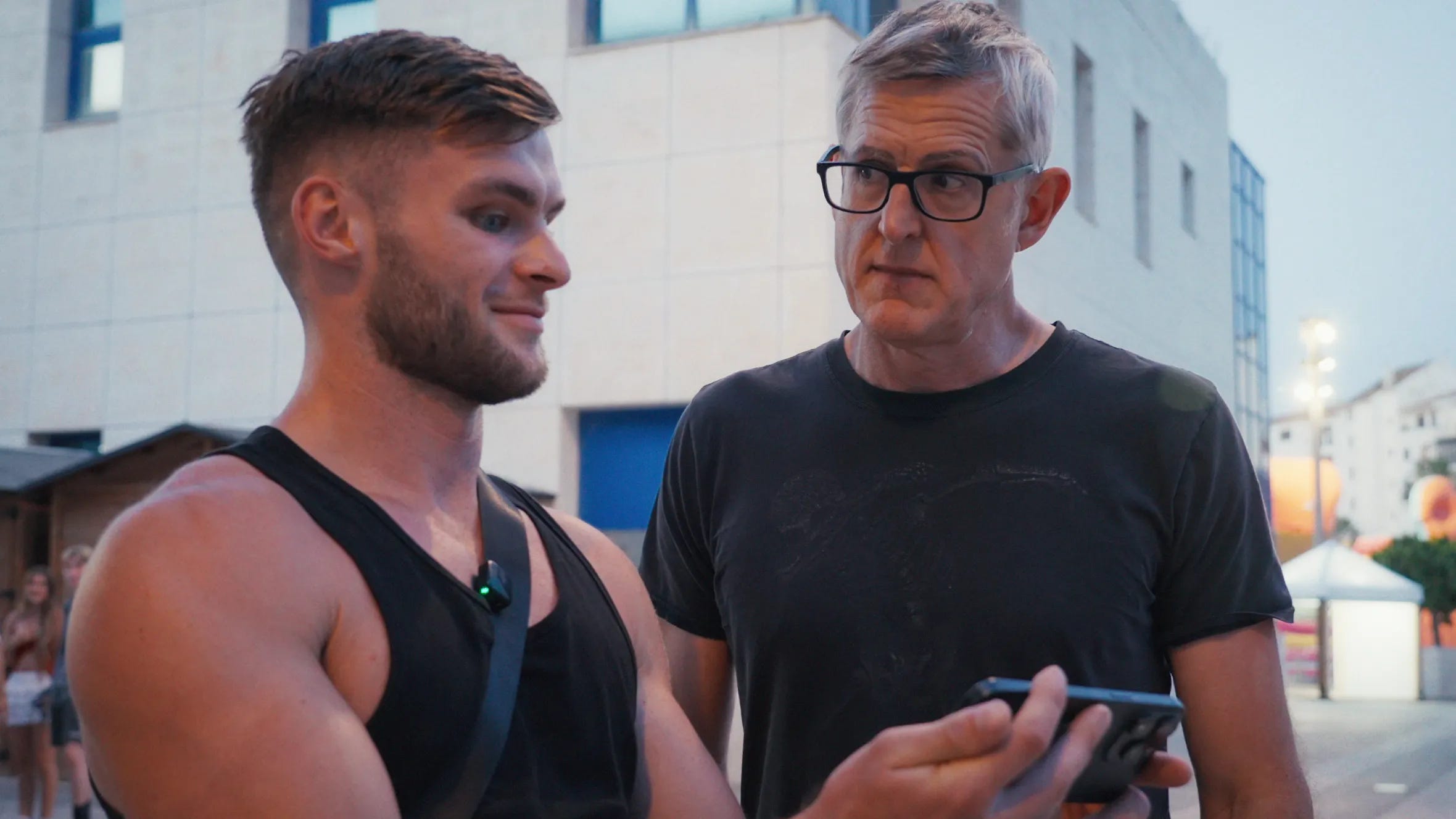
In Theroux’s documentary, some of the leading figures of this cultural phenomenon are interviewed — particularly, the ones with a strong appeal to boys from age thirteen onward: Justin Waller, HSTikkyTokky, Sneako, and Myron Gaines.
The men Theroux interviews share the following traits:
They are obsessed with their physical appearance.
They constantly brag about how much money they make.
They constantly brag about how many women they sleep with.
They are antisemitic.
They are homophobic
They are misogynistic
They spend the vast majority of their time live-streaming
These influencers are so popular among young men that, throughout Theroux’s documentary, you repeatedly see them being chased down the street by packs of teenagers desperate for a photo.
Modern superheroes?
My impression is that, for many boys today, these figures are the equivalent of what superheroes were for kids of previous generations. Like superheroes, they represent — in a cartoonish, exaggerated way — standards that are impossible to reach, and lend themselves to idealization, to becoming material for fantasizing about one’s own life.
Like superheroes, these influencers wear outfits that show off their muscles.


Like superheroes, they spend a significant part of their lives performing for an audience. Unlike superheroes, though, none of these men is trying to save the world. Each of them has only one interest: himself, and the accumulation of wealth that allows him to live in a way that makes him feel clearly superior to everyone else. And who are “everyone else”? Primarily, the people watching from home, who have such low self-esteem that they find the lives of these gonzo-figures as something to strive for.
Unlike superheroes, these influencers don’t appear to have a double life. Superman has Clark Kent. Batman has Bruce Wayne. But who are these men when they don’t have an audience? The question goes unanswered.
These men say they want absolute freedom — no boss, no one to answer to. And yet they livestream for seven or eight hours a day, and let their lives be directed by whoever is commenting on their streams, by whoever likes a video that eggs them on to punch a random passerby, to do one reprehensible thing after another. I can’t imagine a worse nightmare than being puppeted by a mass of strangers using you to live out their fantasies of cruelty.
“If I had only done good things, I never would have become popular on social media,” says HSTikkiTokki to Theroux, when Theroux asks him why he bought a company that manages girls with OnlyFans profiles, given that he claims to find it “disgusting.” He only does it for the money, he says.
The role of social media
The attention economy doesn’t punish the absence of values. It monetizes it.
There is something ferocious in this convergence: a boy who grows up with shame as his only moral compass encounters a system that rewards precisely those who are not ashamed of anything. Whoever is willing to hit someone live on camera, to humiliate a woman in front of a hundred thousand people, to say the unsayable — that person gets views, followers, money.
And here is what Theroux gets exactly right: these men have built their entire lives on the logic of social media algorithms. They told themselves they were escaping the 9-to-5, refusing to have a boss. But they ended up serving a master far more demanding than any employer — one who has absolute control over their lives well past 5pm and long before 9am. The algorithm doesn’t clock out. It doesn’t offer healthcare or weekends. It just requires more.
What Theroux misses
Theroux stops at the comic-book version of the story. What he fails to show is that the manosphere doesn’t live only inside these cartoonish, deliberately outrageous characters. It has seeped — quietly, respectably — into figures who seem far more acceptable. Men like Scott Galloway, professor at NYU’s Stern School of Business, are bestselling authors and guests on every serious podcast and TV talk show. Or Steven Bartlett, the man behind Diary of a CEO, one of the most listened-to shows in the world, whose aesthetic is closer to TED Talk than to Twitch stream.
And yet. Strip away the business school vocabulary and the linen blazers, and the core message is remarkably similar: make more money, optimize your body, improve your performance with women. In his book Notes on being a man, Galloway argues that men must provide, protect, and procreate — and that even if your wife works and earns a full salary, you should still always pay for dinner. He frames this as generosity, even as chivalry. But a man paying for a meal for a financially independent woman isn’t a sign of a healthy, symmetrical relationship. It’s a status symbol. It says: I have enough to make your income irrelevant. The gesture isn’t about care — it’s about hierarchy. And hierarchy, dressed in a good suit and a podcast microphone, is still hierarchy.
The manosphere influencer wants a wife who stays home: it means he earns enough for both of them, and that is the point. Galloway wants something more sophisticated — a wife with her own career, her own salary, her own professional identity. And then he wants to pay for her dinner anyway. Because the ultimate display of male power is no longer making a woman economically dependent on you. It's making her independence economically irrelevant.
The same is true for Steven Bartlett and his uber-popular podcast Diary of a CEO. Adesola has written about it:
Taken individually, any one of these conversations might sound like a clumsy but well-meaning attempt to understand modern relationships. Taken together, they form a consistent worldview: men are suffering because women have too much autonomy; equality has created imbalance; and social progress has left a generation of men behind.
These “respectable” voices in the manosphere aren’t teaching men how to live meaningful lives. They are teaching them, just like HSTikkiTokki and Justin Waller, how to make more money, attract more women, and build a better body. The packaging is different. The product is largely the same.
Theroux doesn’t ask hard questions
This is true, but the few he does ask are enough to unsettle these men.
I don’t think it’s because they’re hiding something. I think it’s because they’ve genuinely never thought about it — they’ve never asked themselves what it means to do something that goes against their own values. I don’t think they even have a clear sense of what it means to have values.
One tiny scene with HSTikkiTokki and his mother — caught off-camera — struck me deeply. They’re about to start filming, and his mother tells him not to be rude, because it would reflect badly on her. In other words, if the son is rude, the mother looks bad. And perception — not substance — is all that matters.
These men didn’t lose their ethical compass as adults. They never received one.
There is a generation that may have grown up with the idea that certain things “cannot be said or done” — not because they are wrong, not because they can hurt someone, not because building relationships of mutual respect preserves our dignity and theirs, but because we risk looking bad. When our moral universe shrinks to what others might think of us, shame becomes the only moral compass we have.
“As men, we are born worthless. It’s up to us to create our value,” says one of HSTikkiTokki’s fans, when Theroux asks which message resonates with him most.
I don’t know about your social media bubble, but in my feminist corner the opinion that men are hopeless is… popular. I was struck by the uncomfortable convergence of opinions between the most extreme corners of toxic masculinity, and some corners of online extreme feminism.
In the first bubble, men are told they are born worthless and must earn their value through money, muscle, and conquest. In the second, men are presumed guilty until proven otherwise — their innocence, like their worth, something that must be demonstrated rather than assumed. The ideologies are opposites in almost every way. But they share a foundation: the idea that masculinity must compensate for a deep deficit.
These figures are offering their audience an out: Yes, it’s true, you are worthless — but only because you don’t have enough money, because your body isn’t perfect enough, because you don’t have enough women. We can show you the way.
The emptiness of values, then, is preceded by an absence of self-worth. If I am worth nothing, how can I have the ambition to believe in something?
We can be outraged at the manosphere
But perhaps we should ask ourselves a better question: how did we contribute to the creation of the void that these men are filling with their hatred and ignorance?
Perhaps our moral panic isn’t that helpful, and rather than demanding our children stay away from this or that influencer, we could try to share with them the search for a deep meaning of what it means to be in the world.
I have the feeling that many of us have learned to be ashamed of asking these large, deep questions — about the horizon of our human experience. We are ashamed to ask them in a political dimension, because we fear appearing naive. We are ashamed to ask them in a religious or spiritual dimension, because we don’t want to seem simple-minded or conservative.
And so we have left the field open. We have ceded the territory of meaning to men who fill it with protein shakes and submission.
But here is what I keep coming back to: the boys are not wrong to be hungry. They are hungry for exactly the right things — purpose, belonging, a sense that their life could mean something beyond their bank balance or their body fat percentage. The manosphere didn’t create that hunger. It just got there first.
Which means we can get there too. Not with better content, not with counter-influencers or media literacy workshops, as useful as those things might be. But with the willingness to sit with a boy — our son, our student, our nephew, our friend — and ask the questions we’ve been too embarrassed to ask ourselves. What kind of man do you want to become? What would it mean to live well? What are you actually for?
These are not naive questions. They are the oldest questions we have. They are the oldest questions we have. And a boy who has someone willing to sit with him inside them — without an answer to sell, without a course to enroll him in — is a boy the manosphere has already lost.
That’s all for today.